
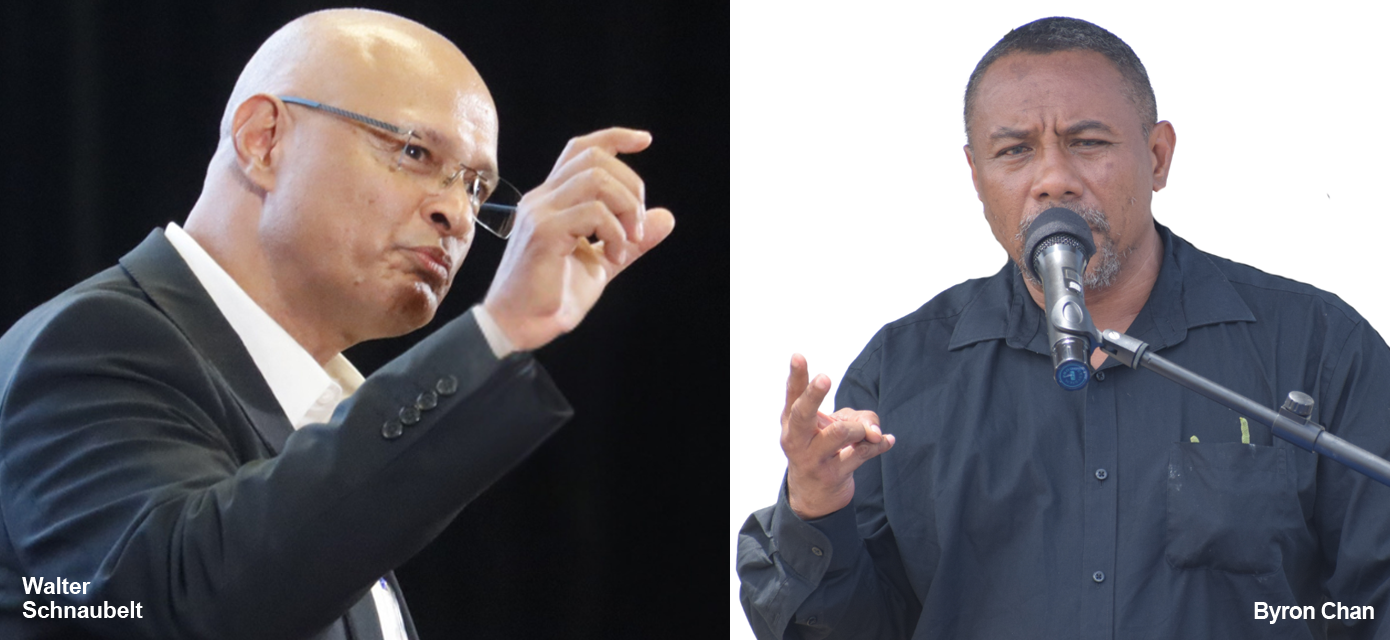

TWO opposing advices exist presently on the position of governor of New Ireland, now that Byron Chan has been declared provincial member following the by-election.
Electoral commissioner Margaret Vagi has said the winner of the election (now Byron Chan) would become governor by automatic operation of Section 17(2) of the Organic Law on Provincial Government and Local Level Government (OLPGLLG).
The secretary of the Department of Provincial and Local Level Government Affairs, Philip Leo, has advised the provincial assembly that Namatanai MP Walter Schnaubelt remains governor as he has been elected following due process authorised by Section 21 of the OLPGLLG.
Legal opinion given by senior constitutional lawyer, Loani Heano, suggests that the Section 21 authority which provides for the minister to direct the provincial assembly to elect a governor following a vacancy occasioned by dismissal from office or appointment to some constitutional office such as minister or speaker, but not on the occasion of death of the incumbent office holder.
Henao holds that in the event of the death of a governor, the law provides for the deputy governor of a province to act in an acting capacity until a by-election installs a new provincial member who then automatically becomes governor.
This is the matter on which Leo is seeking legal clarity.
In the meantime, in a letter to provincial administrator Richard Andia dated Feb 9, 2026, Leo directed that no administrative steps be taken before the department gets legal clarification.
He said the department’s position remained that the provincial member (member of Parliament) was a separate office than that of the provincial governor elected by the provincial assembly.
“Parliamentary membership and by-elections are governed by the Constitution and the Organic Law on National and Local Level Government Elections (OLNLLGE),” Leo said.
“The composition and executive leadership of provincial government are governed by the Organic Law on Provincial Governments and Local-Level Governments (OLPGLLG).
“Section 21 of the OLPGLLG authorises the provincial assembly to elect a governor to fill a vacancy for the remainder of the term.
“Where the assembly has validly exercised that power, the Office of the Governor is lawfully occupied for the residue of the term.
“The OLPGLLG contains no express provision that a provincial member returned at a by-election automatically supersedes an assembly-elected Governor serving the remainder of the term.
“Accordingly, a provincial member returned at a by-election does not automatically displace a governor validly elected by the Provincial Assembly under Section 21.
“The by-election required by the Constitution and the OLNLLGE fills the parliamentary vacancy only; it does not, on its face, alter the provincial executive arrangements established by the OLPGLLG.”
Leo directed Andia to provide the assembly with a copy of this letter and request that it refrains from treating the by-election result as automatically creating a vacancy in the governorship.
He said the by-election result would not automatically displace the assembly-elected governor, including issuing instructions, effecting transfers, or making appointments premised on an automatic change of governor, until:
THE provincial assembly lawfully elects a new governor (vote of no confidence);
THE incumbent governor vacates office (resignation or death); or,
A COURT of competent jurisdiction determines otherwise.