
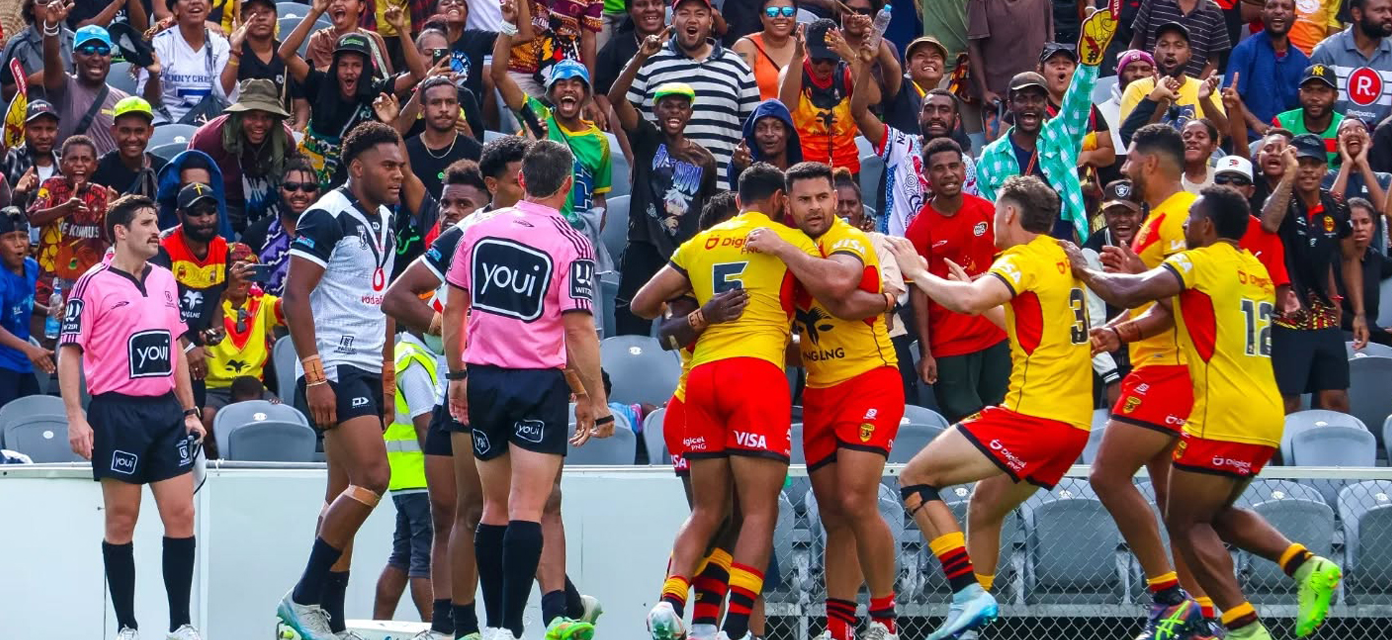

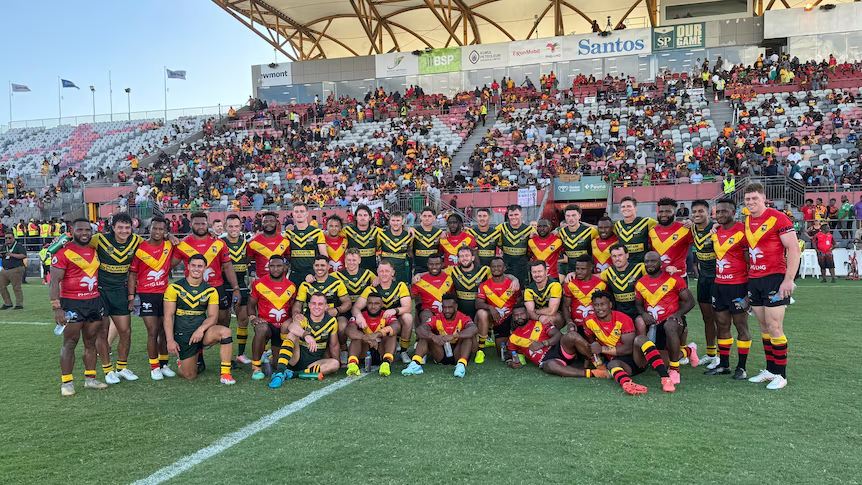
CHIEFS is the official name for the Papua New Guinea National Rugby League (NRL) team, announced by Prime Minister James Marape at the Prime Minister’s 13 fixture on Oct 12 last year.
Rugby league is not only the national sport of PNG but a sport that unites one of the world’s most diverse nations.
PNG and Australia share the same passion for rugby league, with the NRL craze on display during the recent visit to PNG of the Brisbane Broncos NRL and NRL Women’s teams.
PNG’s bid to have a team in the NRL, and Australia’s support for that bid, have been debated both in PNG and in Australia.
But what do Papua New Guineans think?
Absent public opinion surveys, it is difficult to gauge the national mood on key questions such as this one.
We thought we would make a start by finding out what University of PNG (UPNG) students think.
So, we included questions about the NRL bid and Australia’s support for it in the 2025 UPNG student survey, our second annual survey.
Views were divided.
Of the almost 400 UPNG School of Business and Public Policy students we surveyed, 29 per cent said they were very supportive of the bid, 13 per cent said they were supportive, 22 per cent said that they were not very supportive and 25 per cent not supportive at all.
Eleven per cent said they didn’t care.
Overall, it was 42 per cent for (supportive or very supportive) versus 47 per cent against (not very supportive or not supportive at all).
Rugby league is a male-dominated sport, but is loved and watched by almost the entire nation.
However, the two genders showed quite different levels of support for the NRL bid, with male students (the majority) much more supportive than female students.
Overall, whereas 49 per cent of male students were supportive and 44 per cent against, only 27 per cent of female students were supportive while 55 per cent were against, a large and statistically significant difference across genders.
Students were also asked about what they thought of the A$600 million (about K1.79 billion) that the Australian government has put on offer to make the NRL bid happen.
They were given two choices: was this money a good investment or were there more pressing needs that this money could be spent on?
The great majority (71 per cent) thought the Australian money could be better spent on more pressing needs.
Only 29 per cent said it was a good investment.
Even among male students, only one-third thought it was a good investment.
Among female students this share was just 16 per cent: again, a very large and statistically significant difference in the survey.
The students were also given an opportunity to share their views on the idea of a PNG NRL team against the background of the A$600 million investment.
Common positive comments were that this could be an income-earning opportunity and would give tourism a boost.
On the negative side, many said it was an unnecessary expenditure and waste of resources, that PNG was not yet ready for an NRL team, and that the money should be spent in areas of greater need.
No doubt, once the PNG NRL team takes to the field, UPNG students will be out there to support their team, or at least enjoy the games.
At the same time, ordinary people in PNG still face a lot of struggles in their daily lives and lack basic services, and the students’ answers reflect this reality.
Disclosure: This research was undertaken with the support of the ANU-UPNG Partnership, an initiative of the PNG-Australia Partnership, funded by the Department of Foreign Affairs and Trade.
The views are those of the authors only.

Anna Kapil is a Lecturer at the University of Papua New Guinea. She completed a Master of International and Development Economics at the Australian National University. Anna was a Greg Taylor Scholar at the Development Policy Centre.

Stephen Howes is Director of the Development Policy Centre and Professor of Economics at the Crawford School of Public Policy at The Australian National University.