
ALLUVIAL gold panning is becoming a big business in Lumi, West Sepik – although it has associated risks, especially when travelling to sell it.
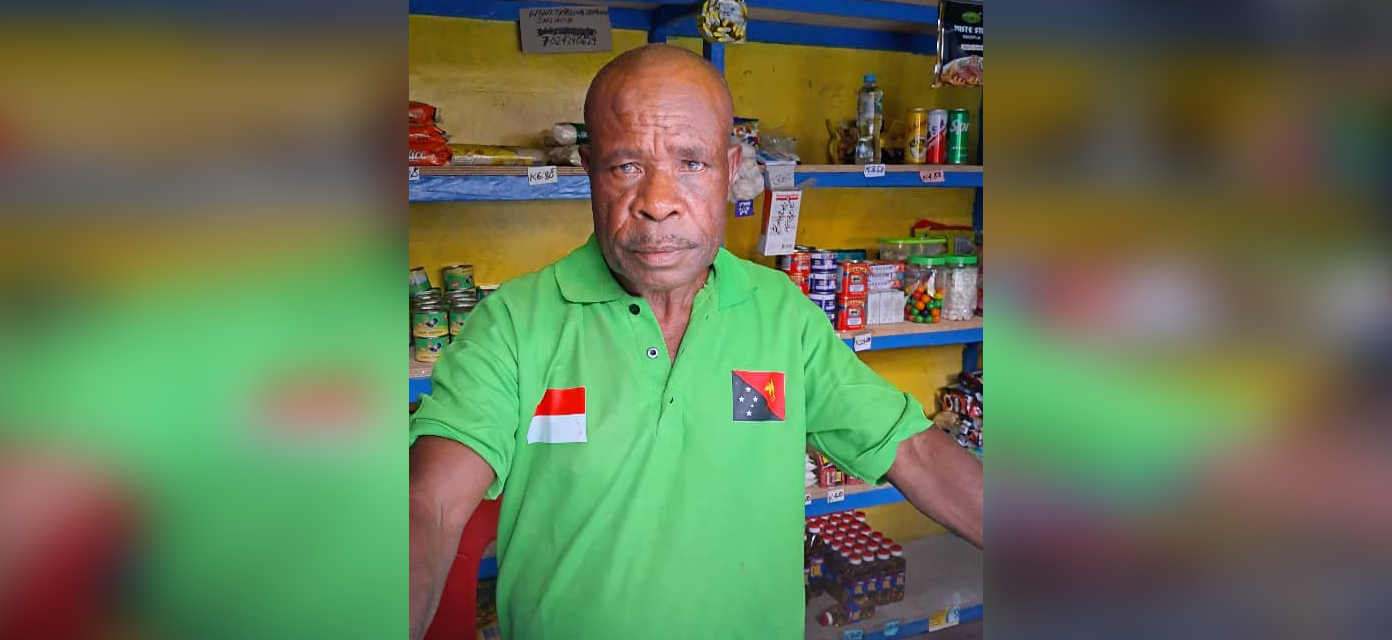
Noel Wowi, 50, a gold buyer in Lumi, hopes that a government agency is set up to buy gold from miners in Vanimo, instead of them travelling out to find buyers.
“The problem is marketing. For buyers, it’s very risky to travel with gold to Maprik or Vanimo to sell. People are monitoring our movements. We risk our lives travelling with it.”
Noel, married with six children and two grandchildren, tries to help the people by buying gold from them and then travelling to Vanimo himself to sell it.
“I’m employed by the Department of Provincial and Local Level Government Affairs. The project that I was working on is currently on hold, so I decided to do alluvial mining while waiting.
“I own a small trade store. People come to me with whatever amount of gold they have in exchange for store goods. If a customer comes with two ounces, which is around K80, and wants store goods, I will tell them to keep K40 and spend the other K40 on store goods. These are some things that I create to help the people.”
The problem is marketing. For buyers, it’s very risky to travel with gold to Maprik or Vanimo to sell. People are monitoring our movements. We risk our lives travelling with it.”
He has a scale for weighing gold, while customers bring their own.
“For points (a measure of the amount of gold on a scale), we get K45 to K50. For one gram, it’s K400 to K500. And if it’s two grams, we are looking at K800 to K1000.”
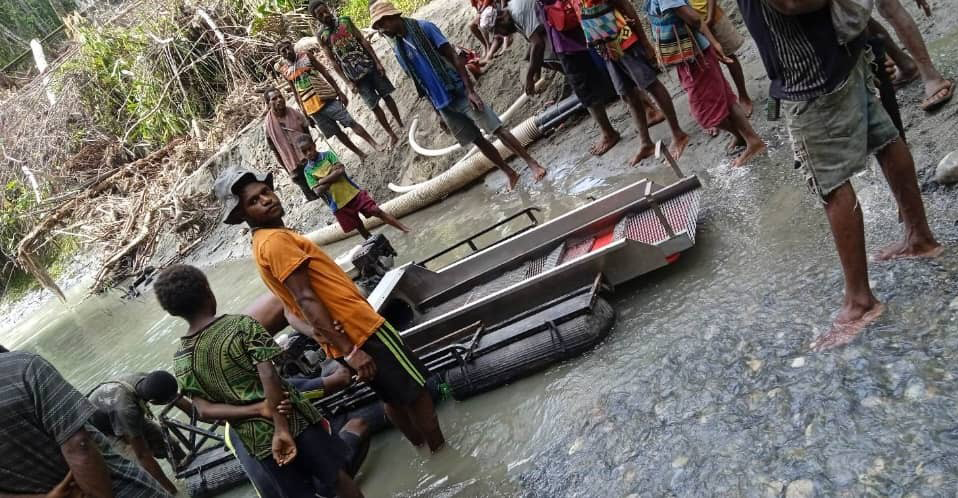
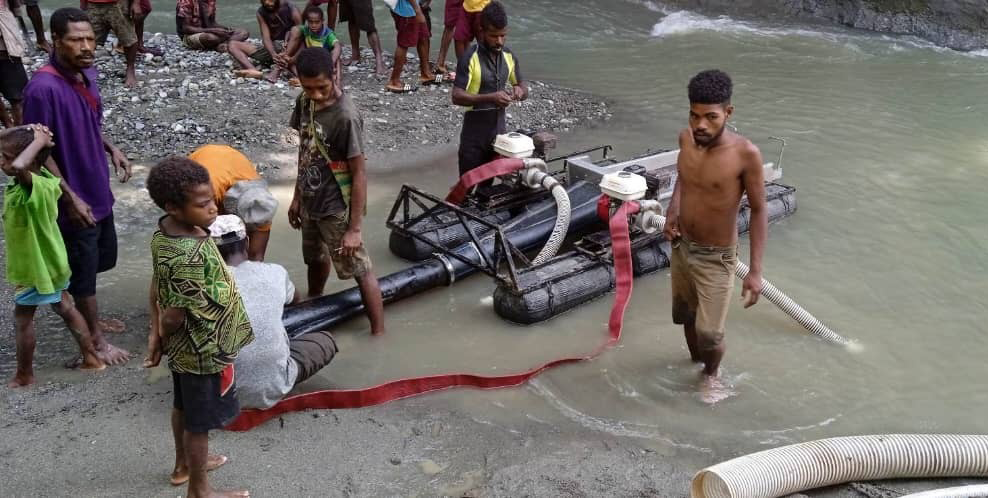
Noel has a dredge to help him and his men in their work.
“Alluvial mining here needs manpower. It takes us a long time to get grams. Mostly we get points. It involves manual labour so it takes a lot of time.
“I bought points or grams of gold and take it to Maprik or Vanimo. There are buyers there that pays more for it.
“We buy K400 here. There, they will add K50 or K80. So we make a little bit of interest. I make around K5,000 as my takings.”
Noel knows that alluvial miners look for the buyer who offers a good buying price.
Noel Wowi’s men testing out the gold dredge at Sibi river, in Lumi
“There are a lot of buyers here in Lumi. So when the customers come to me, I treat them well. I add like an extra K1 on top of the buying price to encourage them to come to me.”
People in Lumi prefer to carry out alluvial mining themselves rather that allowing in outsiders.
“The people do not want investors to come. They don’t want any foreign company to go into their land and use their resources. They want to do the alluvial mining themselves.”
Noel Wowi assisted a customer in weighing his gold in his trade store.
Alluvial gold mining business is tough, as it involves manual labour and the risk one takes in its transportation.
“The problem is when transporting the gold to the buyers. Then they put their lives at risk.
“What we want is to have a good market here so we can set up a good network. Organise ourselves and establish some type of government body here so that we can buy the gold from people and sell it to the established body. And from there, they can find their own way to sell the gold to others. This is the issue that we are facing. It very risky to be walking around with gold we want to find a buyer for.”